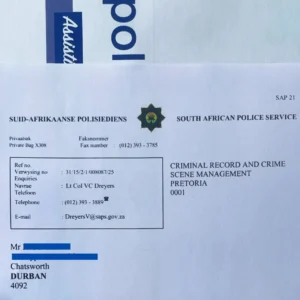
Criminal Record Expungement Assistance (South Africa)

Expungement removes a qualifying conviction from the SAPS criminal record database, so it no longer appears on your police clearance certificate. Not every conviction qualifies, and the rules are set in law.
Police Clear gives general guidance against the published criteria, obtains the police clearance certificate the application needs, and prepares a complete application. From R28,750 including VAT. This is not legal advice.
- Description
Description
Police Clear (Pty) Ltd is an independent document facilitation company. We do not decide expungement applications. They are decided by the Department of Justice and Constitutional Development, which does not charge for the application itself.
What is criminal record expungement?
Expungement is the process by which a criminal record is removed from the criminal record database of the SAPS Criminal Record Centre. Once a record is expunged, the conviction no longer appears on the SAPS criminal record database.
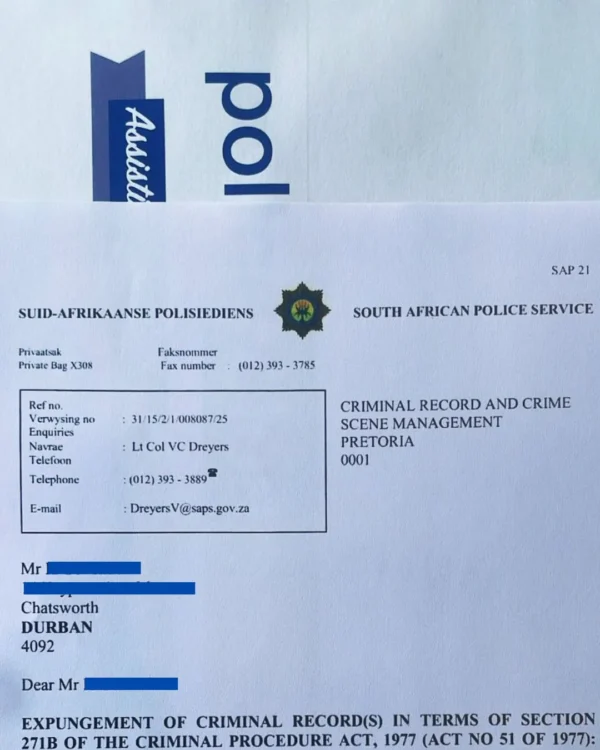
Applications are made under section 271B of the Criminal Procedure Act, 1977, and decided by the Department of Justice and Constitutional Development.
Does your record qualify for expungement?
Under section 271B, the Department of Justice states that a person can apply when all of the following are true:
- At least 10 years have passed since the date of the conviction
- In those 10 years, they have not been convicted and sentenced to imprisonment without the option of a fine
- The sentence was one of the kinds the law lists, such as:
- a fine not exceeding R20,000
- imprisonment with the option of a fine
- a wholly suspended sentence
- a postponed sentence, or being cautioned and discharged
- certain forms of correctional supervision or periodical imprisonment
A record will not qualify where the sentence was direct imprisonment without the option of a fine, or a fine over R20,000. Convictions for sexual offences against a child or a person who is mentally disabled have additional requirements relating to the national registers.
Records for offences committed as a child are dealt with under the Child Justice Act, which follows a different process.
Not sure whether your conviction qualifies? Send us the details and we will talk you through the criteria before you decide.
What our fee covers, and what it does not
The Department of Justice does not charge for an expungement application. You can apply directly.
What our fee covers is the work around it:
- The police clearance certificate needed to start the application, which is included in our price
- Guidance on whether your record meets the criteria before you commit
- Preparing and submitting a complete application
What it does not do is jump the queue. The Department of Justice deals with applications in the order they are received and gives no preference to applications submitted by agencies or representatives. Nobody can legitimately promise you a faster outcome. What a complete, correct application avoids is a delay of its own making.
What you need to start
- Your South African ID or passport
- The details of the conviction you want expunged
How long does expungement take?
The Department of Justice states that it takes 60 working days to decide a complete application, and asks applicants not to enquire before then because enquiries slow the process down. The certificate of expungement then goes to SAPS within 14 working days, and SAPS confirms the expungement in writing within a further 21 working days.
The time spent getting the police clearance certificate and preparing the application comes before that. Timeframes are estimates, not guarantees, and the outcome is decided by the Department.
Criminal record expungement cost
| Expungement assistance, 1 conviction, including the initial police clearance certificate | From R28,750 including VAT |
| Each additional conviction | R7,475 including VAT |
| Department of Justice application fee | None |
Pricing correct as at 16 September 2026. Prices include VAT at 15%, are quoted in South African rand, are subject to change without notice, and are indicative rather than an offer. A binding price is given in a written quotation. Any statutory fees charged by SAPS, Home Affairs or another authority are set by that authority and are payable in addition unless your quotation says otherwise. DIRCO does not charge for legalisation. Timeframes are estimates, not guarantees. Our refund and cancellation terms are in our terms and conditions.
Frequently asked questions
Can my criminal record be expunged?
It depends on the sentence you received and how long ago the conviction was. At least 10 years must have passed, and the sentence must be one of the kinds section 271B lists, such as a fine of up to R20,000 or a suspended sentence. Direct imprisonment without the option of a fine does not qualify.
Is expungement free in South Africa?
The Department of Justice does not charge for the application. Our fee covers the police clearance certificate the application needs, eligibility guidance and preparing a complete application.
How long does expungement take?
The Department of Justice states 60 working days to decide a complete application. The certificate then goes to SAPS within 14 working days, and SAPS confirms in writing within a further 21 working days. Timeframes are estimates, not guarantees.
Can an agency speed up my expungement?
No. The Department of Justice deals with applications in the order received and gives no preference to agencies or representatives.
Will an expunged conviction show on my police clearance certificate?
Once expungement is approved and SAPS has updated its records, the conviction is removed from the criminal record database.
What if I do not qualify?
If your record does not meet the criteria, an expungement application will not succeed, and we will tell you so.
This page describes a document facilitation service. It is general information and is not legal or immigration advice. Requirements and timeframes are set by the relevant department, institution or authority, and change from time to time. Confirm them with that body before you rely on them.